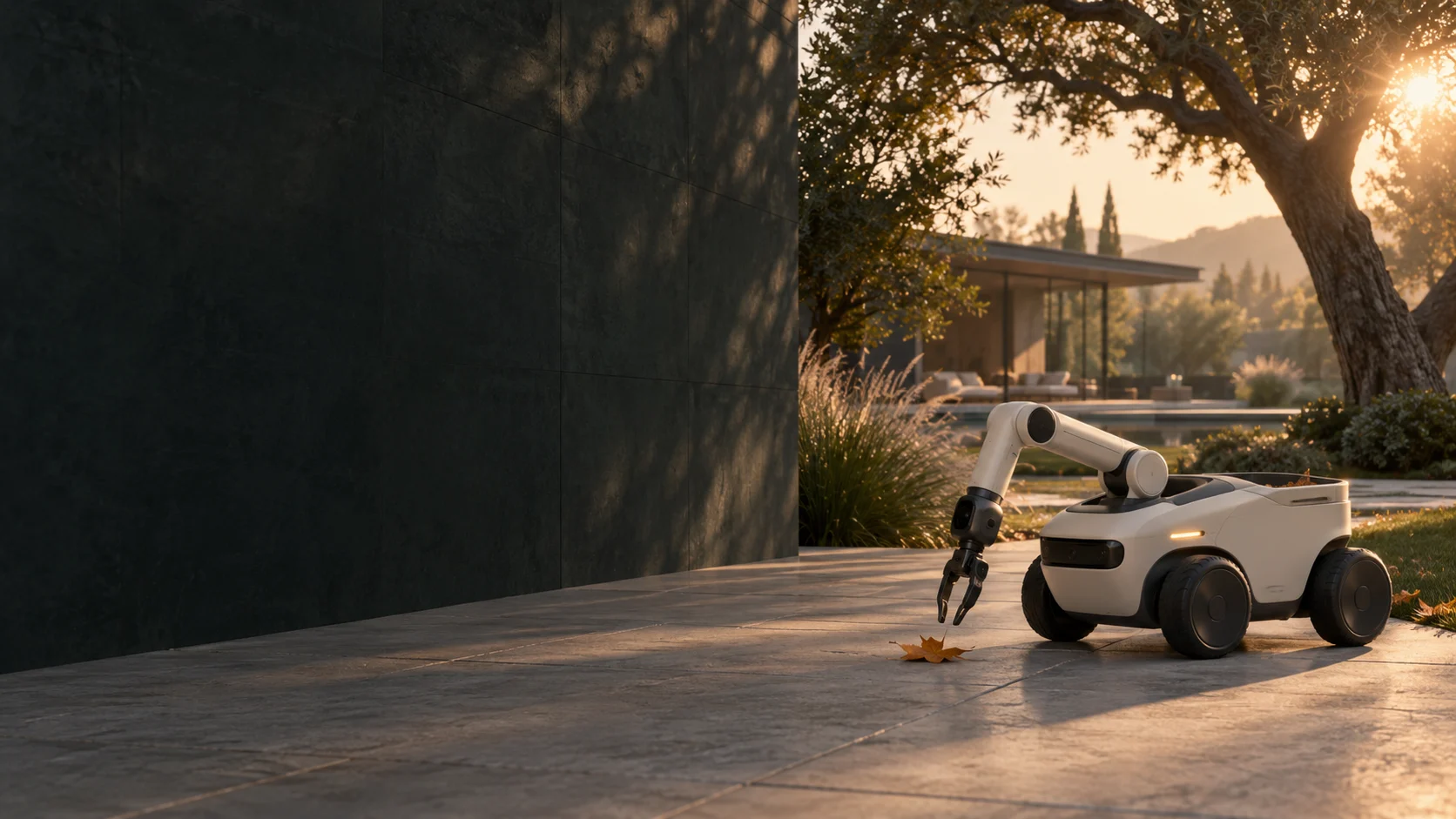
Machines that see,
and learn to act.
BeeMind is our proprietary vision–action model. It translates what a robot perceives directly into continuous, coordinated motion — and refines itself with every attempt.
A single neural network that reads multiple camera streams together with the robot’s own state, and produces continuous motion for base and arm alike. Rather than relying on task-specific rules, it learns from demonstration, from its own attempts, and from failure.
Perceive. Act. Learn.
Three capabilities unified within a single model — rather than separate systems assembled together.
Multi-view spatial understanding
Integrates the main and wrist cameras to locate both the target and itself.
Coordinated whole-body motion
Generates smooth motion sequences for base and arm, correcting continuously as it moves.
Improvement through experience
Demonstration, attempt and feedback form a continuous loop — with no task-specific rules to rewrite.
How BeeMind learns.
Extensive practice in simulation, assessed against real outcomes, with every lesson returned to the model.
Demonstration
An expert policy performs the complete task in simulation.
Attempt
The model acts autonomously, using only camera input and proprioception.
Evaluation
An independent evaluator verifies a single outcome: whether the object reached the bin.
Refinement
Errors are corrected, and each iteration improves upon the last.
Where we stand.
We publish only results that can be independently verified. BeeMind is currently in the simulation phase; real-world deployment has not yet begun.
Perception
Identify objects and the bin
Approach
Navigate from vision to target
Contact
Reach the object
Grasp
Secure a stable hold
Placement
Deliver into the bin
Transfer
Extend to new robots
The first body
of BeeMind.
Hornet is a mobile manipulation platform designed for residential outdoor spaces. It is where BeeMind learns to perceive, approach, retrieve and place.
Product concept · In development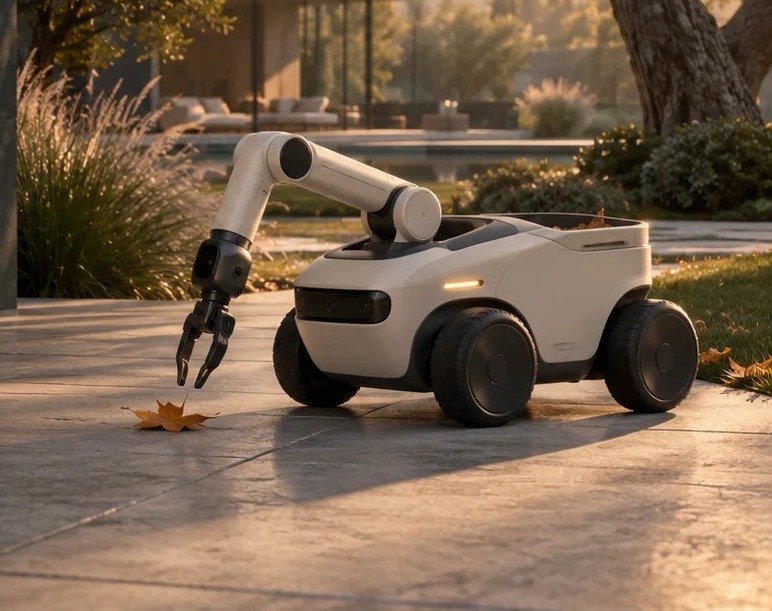
One model.
Many embodiments.
BeeMind is designed to accept a description of a robot’s body, so that a single model may in time learn to control new arms and mobile bases. This is a long-term research direction, being validated step by step.
Research journal.
Concise notes from the laboratory, published at least fortnightly.
Earlier research notes +
Partner with JustBee.
We welcome collaboration with research institutions, robotics manufacturers and early pilot partners.